Smoothie Breakdown Dec 14, 2025
Ok, let’s do a calorie count and look at the vitamins and minerals of this mornings smoothie.
- 2 scoops/1 serving of powdered egg whites 25 g of protein.
- 1 tablespoon of powdered kale
- 16 ounces of soy milk
- 1 banana
- 1 tsp of ground flax
- 1 cup raw oats
- a cup of blueberries
- a few strawberries
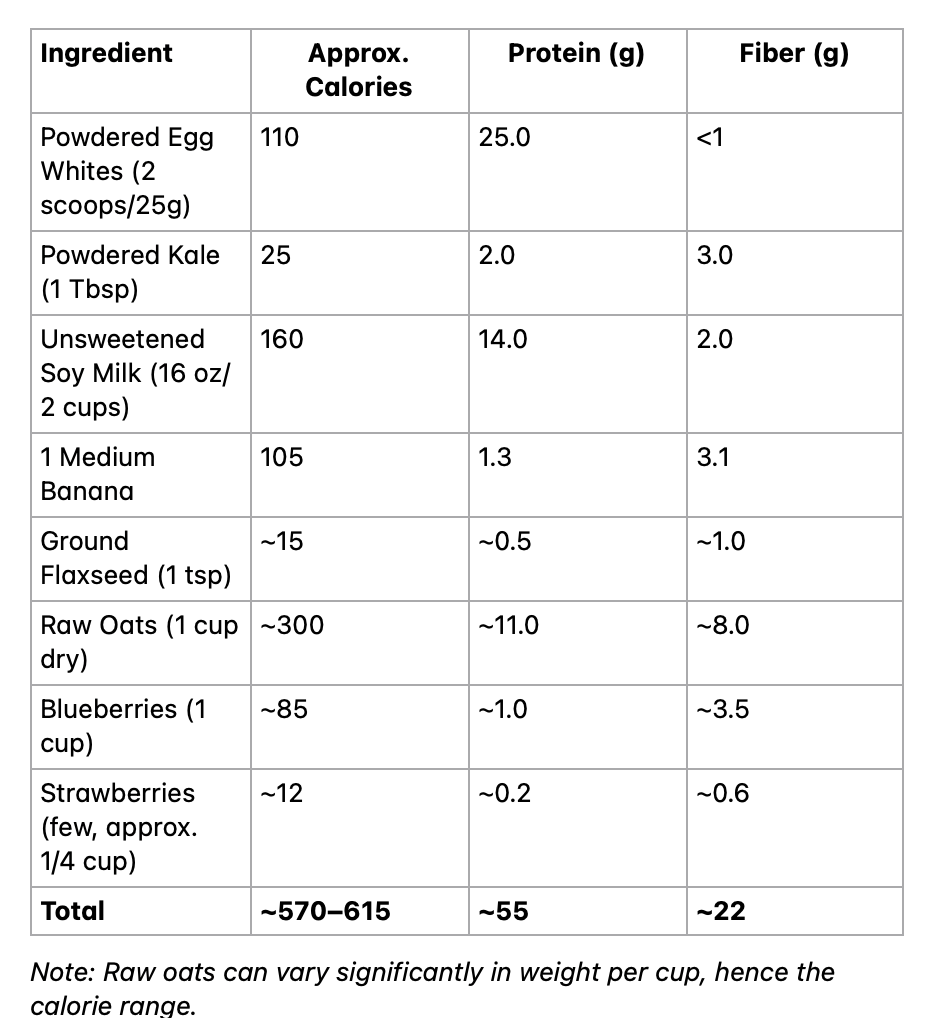
Response from AI– Here is the estimated calorie count and a breakdown of the key vitamins and minerals for your morning smoothie, using average values for the ingredients specified.
Your morning smoothie contains approximately 570–615 calories.
Nutritional Breakdown
This smoothie is highly nutritious, providing an excellent balance of protein, complex carbohydrates, and fiber, along with key vitamins and minerals.
Me- It was a little ‘nutty’, I think from the flax, so I added more blueberries. That’s why it was about a cup. Is there something else I could add that would balance that nutty and let more of the sweetness come through, other than more fruit?
To balance the “nutty” or earthy flavor of flaxseed and kale without adding more fruit, you can use high-potency aromatic extracts, warming spices, or natural sweeteners that won’t significantly change the smoothie’s consistency.
Aromatic Extracts (The “Sweetness Illusion”)
Certain flavors signal “sweet” to your brain even when there is no actual sugar.
- Vanilla Extract: Adding 1/2 to 1 teaspoon of pure vanilla extract is the most effective way to mask earthiness. It provides a creamy, dessert-like aroma that counters the nutty flax.
- Almond Extract: Be careful with this one, as it is very strong; just 1–2 drops can provide a cherry-like sweetness that bridges the gap between your berries and oats.
Warming Spices
Spices can add a “perceived sweetness” while providing their own health benefits.
- Ceylon Cinnamon: Adding 1/2 to 1 teaspoon of cinnamon can balance the bitterness of greens and adds a warm, sweet profile.
- Nutmeg or Cardamom: A tiny pinch of these can provide complex, sweet floral notes that help cover the “grainy” taste of raw oats and flax.
- Fennel Seeds: A small amount of ground fennel seeds provides a light, anise-like flavor that acts as a natural sweetener for green blends.
Non-Fruit Sweeteners
If you need a physical boost of sweetness without the volume of extra fruit, try these concentrated options:
- Stevia or Monk Fruit: These are zero-calorie, plant-derived sweeteners that are much more potent than sugar. A few drops or a tiny scoop can elevate the existing fruit flavors without adding bulk or carbohydrates.
- Date Paste or Syrup: If you aren’t strictly avoiding all sugar, blending in one pitted Medjool date or a teaspoon of date syrup provides a rich, caramel-like sweetness that completely masks bitter or nutty notes.
- Honey or Maple Syrup: A single teaspoon of raw honey or pure maple syrup can dramatically “brighten” the flavor of a large smoothie.
“Hidden” Flavor Bridges
- Lemon Juice: A squeeze of fresh lemon juice can cut through the “muddiness” of kale and flax, making the berry and banana flavors pop more clearly.
- Unsweetened Cocoa Powder: If you like chocolate, a tablespoon of cocoa powder will turn your “nutty” flax flavor into a “nutty chocolate” flavor, which is much more palatable.
- Recommendation for your next blend: Try adding 1/2 tsp of vanilla extract and 1/2 tsp of cinnamon. This combination is highly effective at neutralizing earthy flax and kale flavors while making the natural sugars in your berries and banana taste much more prominent.
Me- What is it missing?
Nutritionally, your smoothie is exceptionally strong, but as of late 2025, new research into “nutrient synergy” suggests it is missing one critical functional component: a healthy fat source to unlock the nutrients in your kale.
The Missing Piece: Healthy Fats
While you have a small amount of fat in the flaxseed and soy milk, it may not be enough to fully absorb the “superfood” benefits of the kale powder.
- Nutrient Bioavailability: Research from December 2025 shows that several key nutrients in kale, specifically carotenoids (which support eye and heart health), have extremely limited absorption when consumed without added dietary fat.
- The “Unlock” Ingredient: Adding just a small amount of a healthy fat acts like a “sauce” for the kale, significantly increasing how many vitamins your body actually keeps.
- Suggestion: Add 1/4 of an avocado or 1 tablespoon of almond/cashew butter. Avocado is particularly good because it adds zero “nutty” flavor and creates a much creamier texture.
Flavor Balance: The “Pinch of Salt” Secret
To address the “nutty” flavor without adding more fruit, the most effective tool in your kitchen is salt.
- How it works: A tiny pinch of salt (less than 1/16th of a tsp) suppresses the bitter/earthy notes of the kale and flax while simultaneously enhancing the natural sweetness of the blueberries and banana.
- Why it helps: Salt makes the individual fruit flavors “pop” so they can stand up to the heavy oats and soy milk.
Strategic “Sweetness” Additions
If you want to move away from the “nutty” profile and highlight the berries, try these non-fruit additions:
- Vanilla Extract: 1/2 teaspoon provides a sweet aroma that tricks your brain into thinking the drink is sweeter than it actually is, masking the flax effectively.
- Ceylon Cinnamon: 1/2 teaspoon adds a warm, sweet flavor and helps stabilize blood sugar, making the oats even more effective for long-term energy.
- Lemon Juice: A small squeeze of lemon or a tiny slice of lemon (skin and all) can provide a “bright” note that cuts through the graininess of the oats and the earthiness of the kale.
Bioavailability Note: Raw Oats & Eggs
- Raw Oats: Eating 1 cup of raw oats provides excellent fiber (around 8g), but some people find it can cause bloating if the oats aren’t soaked first. If you feel “heavy,” try soaking your oats in the soy milk overnight before blending.
- Egg White Protein: You are getting about 25g of protein from the powder, but remember that the body generally absorbs protein from cooked egg whites (91% bioavailability) significantly better than from raw or unheated sources (around 50%). Since you’re using a powder, check if it’s “pasteurized” or “instantized,” which helps with absorption.
Updated Recipe Suggestion: Keep your base, but add a pinch of salt, 1/2 tsp vanilla, and 1/4 avocado to maximize the nutrition you’re currently paying for in that kale powder.
Me- My usual smoothie is a cup of almond milk and a cup of soy milk, but I had soy milk that needed to be used, so all soy milk today. Does almond milk have enough fat?
Almond milk is significantly lower in fat than soy milk, containing roughly 2.5 to 3 grams of fat per cup compared to soy milk’s 4 to 5 grams.
While your normal mix (one cup of each) provides about 6.5 to 8 grams of fat, switching to all almond milk would drop that to roughly 5 to 6 grams.
Is this “enough” for your kale?
Yes, but it’s on the lower end. To maximize the benefits of your powdered kale, your body needs a small amount of dietary fat to absorb its fat-soluble vitamins (A, K) and carotenoids.
- The Minimum Rule: Research confirms that 3 to 5 grams of fat in a meal is the minimum required to trigger the absorption of these nutrients.
- Your Current Safety Net: Even when using all almond milk, your 1 teaspoon of ground flaxseed adds about 1.5 grams of fat, and your cup of raw oats adds roughly 5 to 6 grams of fat.
- Total Fat Check: With almond milk, flax, and oats, your smoothie still totals roughly 12 to 14 grams of fat, which is more than enough to “unlock” the kale powder.
Why you might still want a “fat boost”
If you want to move away from the “nutty” flavor while further improving nutrient absorption, consider these additions:
- Avocado (1/4 of a fruit): This is the “gold standard” for smoothies in 2025. It adds zero nutty flavor, creates a creamy texture like the yogurt you removed, and provides the long-chain fatty acids that researchers say are superior for absorbing kale’s nutrients.
- A “Nano” Drip of Olive Oil: New 2025 research suggests that even a teaspoon of olive oil can dramatically boost kale’s nutrient bioavailability compared to other fats. In a large 16oz smoothie, you likely won’t even taste it.
The Verdict: You don’t need the soy milk just for the fat, but if you switch to all almond milk permanently, adding that small bit of avocado will replace the creaminess of the yogurt and ensure your expensive kale powder isn’t going to waste.
Me- I did say my usual smoothie was a cup of almond milk and a cup of soy milk. Not all almond.
Understood. Your usual base of 1 cup of almond milk + 1 cup of soy milk provides a balanced fat profile that is well within the healthy range for nutrient absorption.
Fat Content Analysis
A mix of these two milks provides approximately 6 to 8 grams of fat. This is widely considered the “sweet spot” for several reasons:
- Absorption Efficiency: Research from late 2025 indicates that roughly 4 to 8 grams of fat is the optimal threshold for absorbing kale’s fat-soluble nutrients (Vitamin K and carotenoids).
- Nutrient Variety: By using both, you get a “best of both worlds” fat profile: soy milk provides heart-healthy polyunsaturated fats, while almond milk adds heart-healthy monounsaturated fats and a natural boost of Vitamin E.
- The Safety Buffer: Your raw oats (approx. 5g fat) and ground flaxseed (approx. 1g fat per tsp) add another 6 grams of fat. This brings your total fat to roughly 12–14 grams, which is more than enough to “unlock” the full potential of your kale powder without being excessively heavy.
Soy vs. Almond: Why the mix works
- Protein Anchor: Soy milk is the heavy lifter here, providing about 7–8 grams of protein per cup (similar to cow’s milk).
- Calorie Management: Almond milk acts as a “thinner,” keeping the total calorie count lower (about 30–60 calories per cup) while contributing extra calcium and vitamins.
Summary of Your “Nutrient Synergy”
Your current recipe is highly optimized for absorption:
- Fat (12–14g total): Unlocks the Vitamin K and A in the kale powder.
- Vitamin C (from berries): Dramatically increases the absorption of the plant-based iron found in your oats and soy milk.
- Probiotic Option: Since you’re moving to the “Lazy Probiotic Hack” (capsules), you avoid the heavy “casein plug” of dairy yogurt while keeping the gut benefits.
Final Verdict: Your 1:1 milk ratio is excellent. It provides enough fat for absorption while offering a more diverse nutritional profile than using either milk alone.
Me- On the probiotic capsules. You suggested opening one into the smoothie. Does that increase its availability over just swallowing the capsule?
Opening the capsule into your smoothie does not necessarily increase the probiotic’s availability, but it may actually increase its survival rate through your stomach acid.
While the capsule’s primary job is to protect the bacteria, 2025 research suggests that a “smoothie environment” provides a unique biological shield that can be just as effective as the capsule itself.
The “Juice Carrier” Protection
New studies in 2025 have found that “pre-hydrating” dry probiotic powder in a fruit or vegetable liquid significantly enhances its resistance to stomach acid.
- The Buffering Effect: The ingredients in your smoothie (like soy milk, oats, and fruit) act as a “buffer” that neutralizes some of your stomach’s harsh acid (pH), creating a safer passage for the bacteria.
- Nutrient Support: The presence of glucose (from the banana and berries) and fats (from the soy milk and flax) has been shown to increase the survival rate of probiotic strains by up to 10 times compared to taking them with just water.
When to Keep the Capsule Whole
You should only swallow the capsule whole if it is explicitly labeled as “Enteric Coated” or “Delayed Release”.
- Specialty Coatings: These specific capsules are designed to not dissolve until they reach the small intestine. If you open these, the bacteria may be destroyed by your stomach acid before they get where they need to go.
- Standard Capsules: Most daily probiotics (including the Garden of Life 3-in-1 you looked at) use standard vegetable capsules that dissolve quickly in the stomach anyway. For these, opening them into a smoothie is perfectly fine and often recommended for those who dislike pills.
Two “Golden Rules” for Smoothie Probiotics
If you choose to open the capsule into your blend:
- Add it LAST: Do not blend the probiotic powder at high speeds, as the heat and friction from the blades can damage the live cultures. Stir it in or give it a final 2-second low-speed pulse.
- Drink it Immediately: Once the “dormant” dry bacteria hit the moisture of your smoothie, they become “activated”. You should drink the smoothie within 30 minutes to ensure they are still at peak potency when they enter your system.
Verdict: For your specific routine, opening a standard probiotic into your smoothie is a “win-win.” It eliminates the pill-swallowing step and uses your high-fiber, high-fat smoothie as a protective vehicle to deliver the bacteria safely to your gut.